
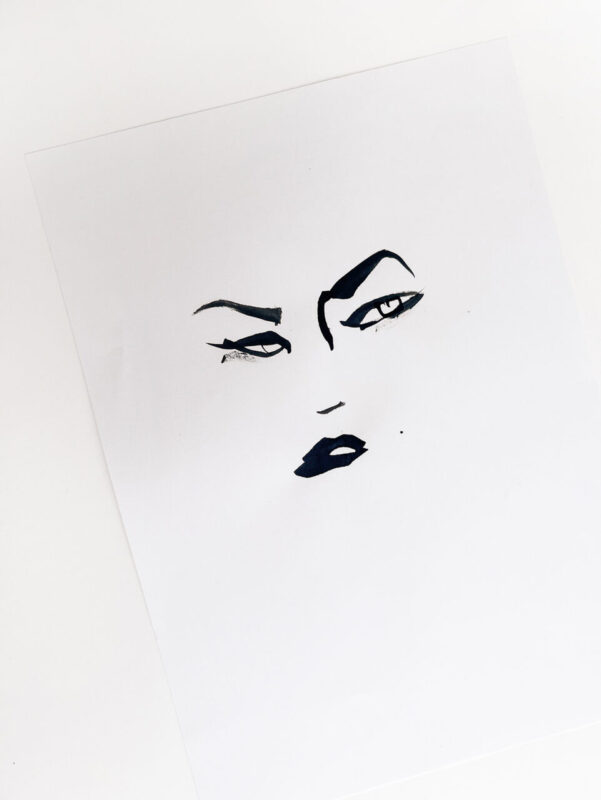
Artwork Details
Medium: Analog ink drawing (sumi ink, brush)
Subject: A fleeting gaze caught between sorrow and anger; the story of facial muscle and expression
Theme: The boundary between consciousness and unconsciousness, visualizing inner emotions
Artist: Visual Story Artist Kazue Shima
The Story
Thinking about how an expression comes to be applies not only when I draw, but to my own face as well. In the end, both are a question of facial muscles. So what moves these muscles, shaping each feature?
It is, of course, a matter of signals from the brain—but I find myself caring deeply about its dual nature: the biological logic that automatically shifts between conscious and unconscious sources, and the dramatic truth that it also serves as a mirror reflecting the emotions welling up from deep within.
When I draw a face, I move my pen or brush while holding onto a certain emotion. That emotion becomes a line—joy or sorrow, frustration or longing, hope, or even a tremor of the heart wishing to hide away somewhere—drawn out across the paper.
The smallest shift in one’s state of mind appears instantly as the depth of the eyes, the height of the brows, the shape of the mouth.
This particular gaze—caught between sorrow and anger, shown almost by accident—may have come from a film I’d watched not long before, one that left my heart somewhere behind.
The story, rewritten inside me, may have quietly taken on my own emotion.
During my time as a model, I would always tense up before the camera, and my expression would stiffen. “Raise your eyebrows until your forehead can’t wrinkle anymore, then gently lower only the eyebrows back to their normal position”—a technique passed down by a senior model, meant to make the eyes look their largest and most composed.
Even now, I catch myself doing it whenever a photo is taken.
But rendering a facial expression by hand into a two-dimensional world demands something more than surface technique; it requires a deeper story beneath it, as I have come to understand through long experience.
My brain, it seems, works more actively when I am drawing a story with my own hands than it ever does in front of a camera.
Materiality & Context
The formation of facial expressions ultimately comes down to the mechanics of facial muscles. Art history holds names like Charles Le Brun, who scientifically and anatomically explored the relationship between human passions and muscle movements.
Yet, while a camera records external light and muscle contractions, I believe a hand-drawn illustration holds the privilege of expressing the narrative seeping from within.
This is exactly why I chose the brush and ink.
The fading and wavering of the ink, never fully controllable, feel like the perfect material to visualize this duality—the biological logic that switches automatically between conscious and unconscious, and the dramatic truth beneath it.
A different kind of line emerges here, distinct from the unconscious line of the aluminum pen—one that comes only from accepting this duality.
Stripping away the easy phrase of a “composed expression,” this face—built from nothing but ink and a tangle of conflicting emotions—turns the question back on the viewer.
A deep human story can never be told through a single emotion alone. What your eyes are seeing is not as simple as it appears.
And perhaps holding that confusion, even briefly, becomes something worth keeping.

