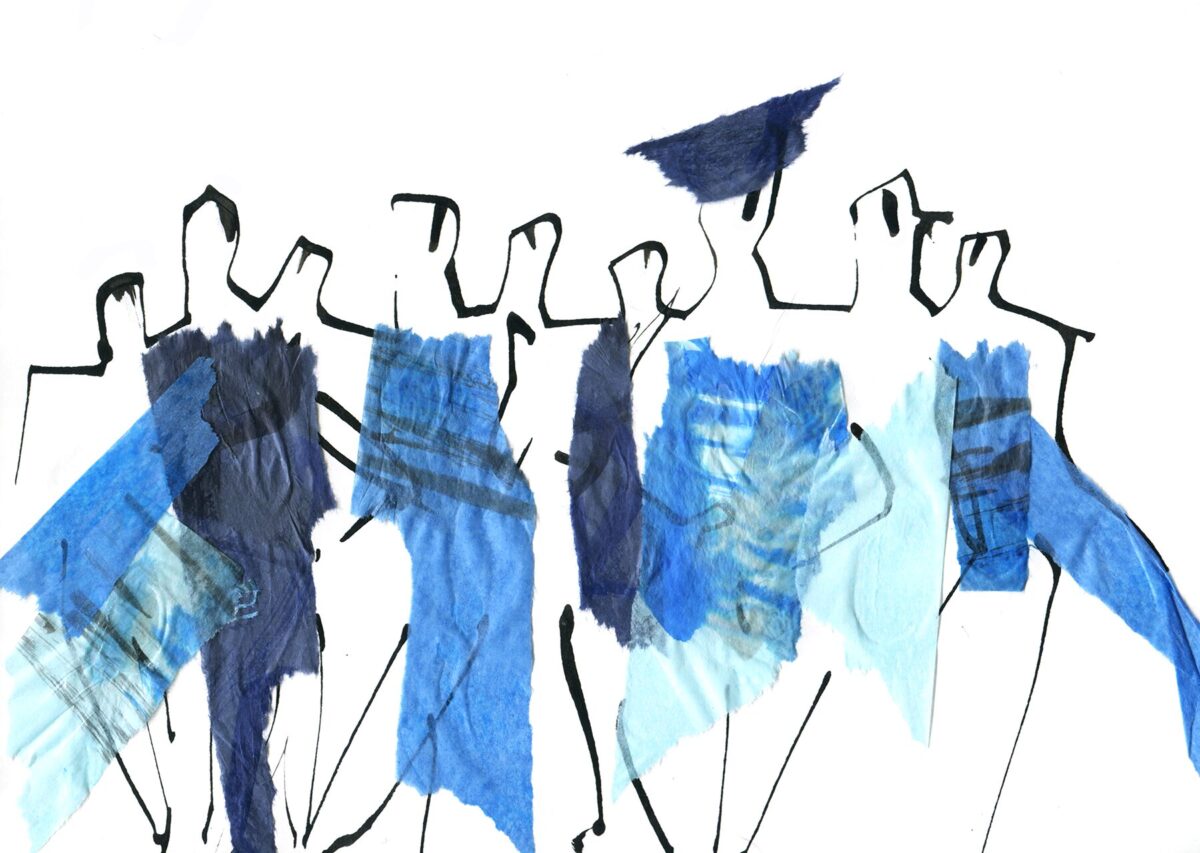
Runway models drawn with a self-made pen from folded aluminum and ink, with blue tissue paper applied as clothing. Tissue paper painted by Kazue Shima herself.
Kazue Shima Visual Story Artist
Artwork Details
Medium: Analog mixed media (aluminum pen, brush, blue tissue paper collage)
Subject: Models standing side-by-side in a runway finale
Theme: The heat of the fashion show, 3D spatial awareness, and the dream of wearing clothes
Artist: Visual Story Artist Kazue Shima
The Story
Runway finales have increasingly become a style where models walk in a single file, still in their final looks. But I remember a time when the ending was almost always a wide row of models standing side by side.
The shift toward walking in a line probably comes from a preference for showing the flow of the garment, the cut, the silhouette, in a cooler way. And with smartphones and live streaming as the dominant media now, movement down a runway carries more of a live, fast-paced energy than a static row ever could.
It’s smart, certainly, and it makes each individual piece and its craftsmanship easier to read. But a finale where everyone stands in a single row holds a kind of drama that a line of walking models never can — the drama of a single tableau, a group portrait.
Standing on that stage, we felt that narrative in our own bodies. The way the audience’s eyes moved, the air in the room — it was entirely different between walking in a line and standing shoulder to shoulder. You only really understand this once you’ve actually stood there yourself.
Even a collection from a house far smaller than the grand maisons will usually show around fifty looks.
Starting from the first look, the audience becomes fixed on each piece as it’s revealed one by one, anticipating what’s coming.
And then, at the end, the entire collection comes together in a single row on stage — a gradient across the whole line — and the world of that collection is reaffirmed all at once.
Unlike a style that simply walks past and disappears, this lets you take in the whole flow, slowly, together.
Maybe, by today’s standards, that’s an excessive kind of glamour. But I think the people who come to a collection want to see drama.
More than anything, that row of mannequins standing shoulder to shoulder becomes the final runway of honor — the whole room paying tribute, together, to the designer who built this beautiful next season out of nothing.
The heat radiating from the models standing on either side of me. The audience, electrified by the latest reveal, caught up in its story.
In that moment, in that place, the one true thing I received from the world could only have come in that exact form.
Materiality & Context
I run my hands over the blue tissue paper, feeling its texture, and imagine a story of figures standing in a row.
The world of color opens up endlessly inside me — sometimes like the waves of the deep sea, sometimes like the layered shimmer of a sapphire.
When the paper itself needs more expression, I add brushwork on top of it — a process that, for me, feels like the excitement of building an entire stage.
Then, with the aluminum pen, I draw the rough outlines of the models entering the stage all at once, and scatter this hand-torn blue across them. As the shades of blue overlap, a sense of balance and depth naturally emerges — but I make a point of not calculating exact distances or a too-perfect balance in my head.
Two-dimensional representation is a precarious thing. My body knows that as a garment moves, how it looks from all 360 degrees changes instantly. The overlapping shades and balance that come from movement are never fixed — they shift constantly.
So when I layer the paper, my mind moves into a three-dimensional state, and trusting that in-the-moment feeling is what feels most right to me.
Thinking about how people might receive this story of overlapping blues, and how I want it to be received — I come to understand that wearing clothes is, at its core, a way of carrying both the challenge and the dream of living.

